

Waste Reporting
Effective waste reporting is the foundation of every successful Zero Waste sustainability program. Clear and accurate data helps your organization:
- Benchmark current state of waste efforts
- Highlight opportunities for improvement
- Communicate findings and progress
- Demonstrate meaningful environmental performance
Waste Reporting can transform waste from a cost center into a strategic asset. Effective waste reporting can help drive efficiency, reduce costs, meet regulations and compliance, and advance sustainability goals.
By focusing on actionable metrics, organizations can turn waste data into a driver of both environmental and financial performance.
Urban Impact helps organizations track all waste reduction efforts — recycling, shredding, reuse programs, and other diversion activities.
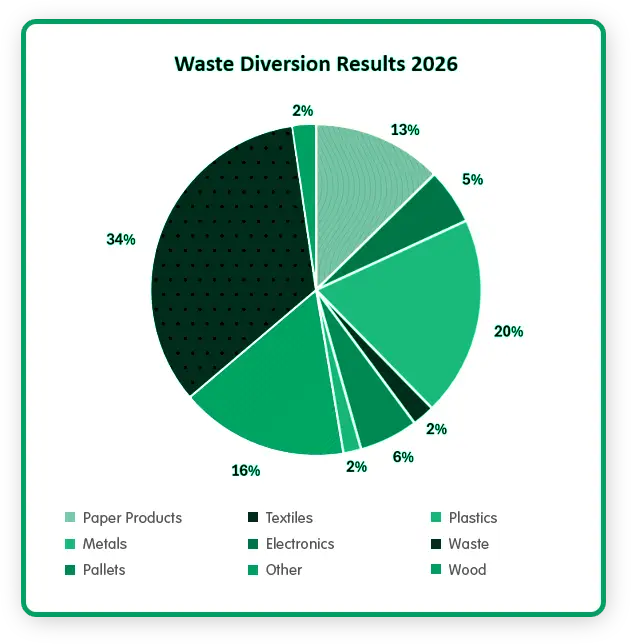

Top Six Reasons to Implement Waste Reporting
Waste Reporting Is Critical for Your Business
Waste Reporting is essential for environment protection, legal compliance, and sustainably goals. It is also a critical component for any organization in achieving their Zero Waste goals. Waste Reporting helps businesses stay compliant, avoid fines, and support enforcement efforts by environmental regulators. It ensures that waste generation, handling, and disposal are transparent, accountable, and aligned with regulatory requirements.
-
1
Regulatory Compliance
Waste reporting helps businesses meet provincial, municipal and regional requirements, avoid fines, and stay ahead of tightening waste management regulations and regional goals.
-
2
Cost Reduction
By understanding what materials are being thrown away, companies can identify heavy or high volume waste streams, reduce landfill disposal fees, and optimize collection schedules.
-
3
Improved Diversion Performance
Clear data reveals where recycling systems are working—and where they’re not—allowing organizations to increase diversion rates and reduce environmental impact.
-
4
ESG and Sustainability Reporting
Waste reporting strengthens the Environmental pillar of ESG by providing measurable, auditable data that supports sustainability claims and builds stakeholder trust.
-
5
Operational Efficiency
Quantifying waste streams helps businesses identify inefficiencies, streamline processes, and adopt waste prevention strategies that support a circular economy.
-
6
Transparency & Accountability
Standardized reporting creates clear responsibility for waste handling and allows regulators, industry peers, and customers to evaluate performance and best practices.
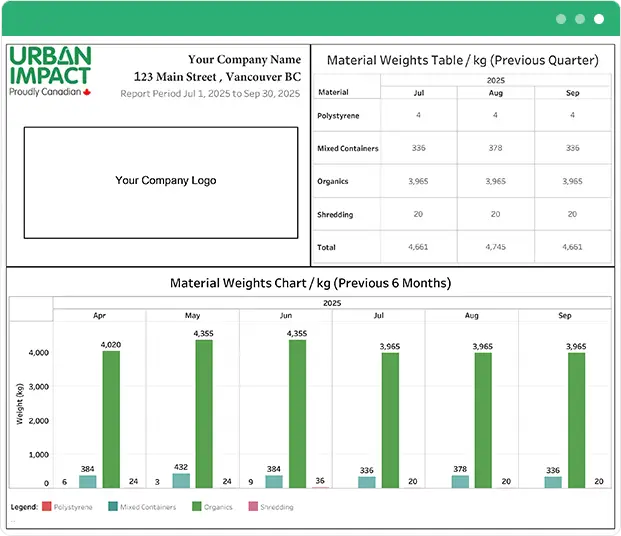
Customized Waste Reports for Stronger Diversion Results
Urban Impact provides a range of reporting options designed to give you the insights you need to strengthen diversion efforts and meet sustainability goals. Our reporting can be customized to your business, your facilities, and your internal systems.
- Diversion % by period — rack how your diversion rate changes month-to-month or year-to-year.
- Diversion by weight table — clear breakdown of materials collected by weight.
- Diversion by weight totals — Summaries that show exactly how much material your site is diverting.
- Diversion per capita — Insight into how individual employees or tenants contribute to diversion.
- Diversion compared to industry — Benchmark your performance against similar organizations.
Why Choose Urban Impact
Urban Impact helps you build a waste reporting system that is accurate, practical, and aligned with your sustainability goals. Our approach is grounded in real world experience — not theory.
Our team supports you through the audit process, identifies actionable opportunities, and provides sustainable, long term solutions to strengthen your waste management system.
We are not a consulting firm. We are a full service Zero Waste and recycling company with more than 35 years of hands-on field expertise. We work directly with businesses every day, solving real operational challenges and improving diversion outcomes across all types of facilities.
The advantage of partnering with Urban Impact is simple: we are committed to helping you recycle more and waste less. It’s at the core of who we are.
“An economy where we can divert, reuse and recycle resources or packaging that are at end of life and use them as a resource for new materials is a real goal and would truly allow us to call our economy circular. Waste Reporting and its analysis plays a critical role in the circular economy.”